“You gotta dance”
The Amazing Maurice and His Educated Rodents“You gotta dance” is Sardines’s compact principle of adaptation: when circumstances keep moving, survival requires more than strength or a good plan; it requires responding to the moment. The phrase first becomes explicit as advice to Darktan, then gains a public, practical meaning when Sardines performs for the humans of Bad Blintz. At the novel’s close, its rhythm returns in the narrator’s reflection on stories that continue, carrying the maxim beyond the immediate problem of leadership and into the book’s larger concern with how to live in a changing world.
A lesson in leadership
Before Sardines tells Darktan to dance, he has already identified leadership as a kind of performance. Drawing on his experience of hanging around the theatre, he tells Darktan that a leader must act as though he knows what he is doing: if the leader appears uncertain, the others will be uncertain too. Darktan answers that he knows what he is doing only when dismantling traps. Sardines’s counsel therefore begins with a gap between Darktan’s practical competence and the confidence his new position demands.
Sardines tries to bridge that gap by recasting the unknown future in terms Darktan understands: “All right, think of the future as a great big trap,” he says, “With no cheese.” The comparison is comic, but it also acknowledges that Darktan cannot rely on the familiar signs or rewards of a trap-dismantling job. Sardines follows it with advice about the scar on Darktan’s face: Darktan should let the others think what they like about it. Together, these suggestions present leadership as an ability to manage uncertainty and appearances, not simply to master a technical task.
From advice to public performance
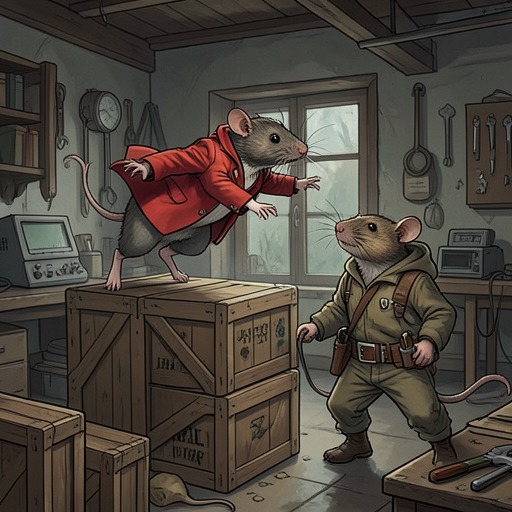
The phrase acquires its clearest practical force when the rats must deal with the humans of Bad Blintz. Maurice argues that the people of the market town do not understand the tunnels and must be approached in a way they can understand. He sketches a process of shouting followed, eventually, by talking, but the rats remain bewildered. Turning to Sardines for help, Maurice receives an immediate answer: “He's right, boss. You've got to give 'em a show.”
Sardines does not leave “show” as an abstraction. He dances a few nervous steps, raises his hat, and twirls his cane. A couple of humans see him and chuckle. Darktan fears that the humans will laugh at the rats; Sardines answers, “Better laugh than scream, boss. It's a start.” His performance supplies evidence for the strategy in the moment: laughter is a less hostile response than fear, and a small, visible gesture can begin the approach to conversation that Maurice has described.
Sardines then expands the tactic into the maxim itself: “You gotta dance, boss. You can think and you can fight, but the world's always movin', and if you wanna stay ahead you gotta dance.” The line does not reject thought or fighting; it places them within a world that will not remain still for either. The dance stands for the adjustment that follows from that motion: a response fitted to changing circumstances rather than a demand that circumstances conform to the rats’ expectations.
A place to stay, a world to meet
The exchange also sets Sardines’s flexibility against Darktan’s reluctance. After Dangerous Beans expresses a hope that there might be an island where rats could really be rats, Darktan recalls what they have seen and doubts that a wonderful island lies ahead for people like them. He concludes that if such an island exists anywhere, it is here, but adds that he does not intend to dance. His answer affirms the possibility of belonging where they are while resisting Sardines’s chosen image for adapting to human society.
That tension matters: the advice is offered, but the scene does not say that Darktan accepts dancing as his own manner of leadership. Sardines’s demonstration instead makes adaptation concrete for the group and for the humans watching. The humans’ chuckle does not resolve every difficulty between them, but it marks a change in the immediate encounter—from bewilderment and anticipated hostility toward a form of contact the humans can recognize. The maxim is thus practical without being a guarantee of easy acceptance.
The closing refrain
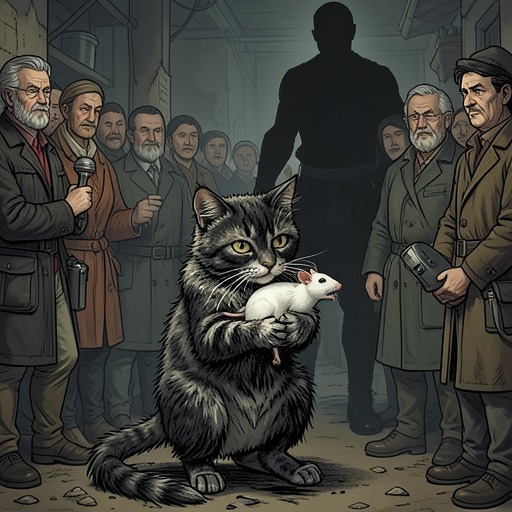
At the end, after the cat follows the boy to the first milestone on the road, the narration returns to the phrase’s underlying logic: “Because some stories end, but old stories go on, and you gotta dance to the music if you want to stay ahead.” The wording recalls Sardines’s counsel, while widening its frame. What began as guidance for a rat leader and then became a tactic for approaching townspeople now describes how old stories persist and how those living within them must keep moving.
The final recurrence also preserves the expression’s combination of continuity and change. Stories may end, but old ones go on; the world’s motion does not erase what came before, yet it makes a fixed response inadequate. “You gotta dance” is therefore more than an instruction to entertain an audience. Across its appearances, it links confidence, performance, negotiation, and the ongoing work of meeting circumstances as they change. The closing line makes that adaptive motion part of the novel’s final cadence.